AI & Machine Learning for Civil Engineers
From Engineering Data to Prediction, Explainability & Uncertainty
A live, code-along online workshop that takes Civil Engineers from raw engineering data to trustworthy ML predictions, explainable models and an introduction to uncertainty quantification. No prior Python or Machine Learning experience required.
No coding experience needed. Learn live in your browser.
- 8
- Live sessions
- 90 min
- Per session
- 12 hrs
- Live instruction
- Google Colab
- Code in browser
- 17 Oct
- Cohort starts
- Live
- Online format
- 6-step
- Practical workflow
- Civil
- Engineering focus
Participants will not need to install Anaconda, MATLAB, or any other desktop software throughout the course. All coding and exercises will be conducted through Google Colab.
One engineering workflow, start to finish
Follow one practical process from an engineering question to a prediction you can explain.
- 01Define an engineering problemFrame a question worth answering.
- 02Understand the dataFind the signal in real measurements.
- 03Build a modelTrain a useful first model.
- 04Validate itTest it against unseen data.
- 05Interpret itSee what drives its predictions.
- 06Use the prediction responsiblyBring judgement back to the decision.
Rather than teaching programming or algorithms in isolation, the workshop follows a continuous engineering workflow: define an engineering problem, understand the data, build a model, validate it, interpret it, and use the prediction responsibly in an engineering context.
The course is deliberately broader than a typical Machine Learning course. Examples span concrete materials, buildings and energy, transportation, environmental and water engineering, and geotechnical engineering, with additional depth in geotechnics and reliability/uncertainty quantification drawn from the instructor's research.
Who it’s for
- B.Tech./B.E. and M.Tech./M.E. Civil Engineering students
- Ph.D. scholars and early-career researchers
- Faculty members interested in data-driven engineering
- Civil, structural, geotechnical, transportation, environmental and water engineers
- Practitioners who want an introduction to practical ML workflows
- Participants who have never programmed in Python
No prior Python, Machine Learning or advanced mathematics is required. You should have a basic understanding of Civil Engineering concepts and be comfortable with ordinary engineering calculations.
What you’ll be able to do
Make sense of engineering data
- Understand AI, Machine Learning and Deep Learning in an engineering context.
- Translate a Civil Engineering problem into an ML problem using inputs/features and a target/output.
- Work with engineering datasets using Python, NumPy and pandas.
- Perform practical exploratory data analysis and prepare datasets for ML.
Turn data into predictions
- Build regression models for engineering prediction.
- Build classification models for engineering decision problems.
- Compare linear, tree-based, ensemble and neural-network approaches.
- Evaluate model performance using appropriate engineering and statistical metrics.
Know when to trust a model
- Recognise common failure modes such as data leakage, overfitting and extrapolation.
- Use feature importance and SHAP-style explainability to investigate model behaviour.
- Understand why a point prediction may be insufficient when engineering inputs and outputs are uncertain.
- Use Monte Carlo simulation with an ML/surrogate model as an introduction to uncertainty quantification and reliability analysis.
8 live sessions
Each session pairs a core ML idea with real problems from across Civil Engineering.
Find your footing
Python, Colab and engineering data
01Live session 1AI & Machine Learning for Civil Engineers: From Engineering Problems to PythonWrite your first code in Colab and see an engineering dataset take shape.
AI/ML concepts · Google Colab · Python · NumPy · pandas · First plots
Engineering measurements & material properties
02Live session 2From Raw Engineering Data to an ML-Ready DatasetClean and inspect real measurements before any model sees them.
EDA · Data quality · Outliers · Correlations · Train/test split · Scaling · Leakage
Materials, environmental & engineering datasets
Build the model
Prediction, nonlinear methods and classification
03Live session 3Your First Engineering Prediction ModelBuild a baseline prediction and read its errors honestly.
Linear regression · MAE, MSE, RMSE · R² · Residuals · Cross-validation
Strength & engineering response prediction
04Live session 4Nonlinear Engineering Problems: Trees & EnsemblesCompare models when a straight line cannot explain the data.
Decision trees · Random Forest · Boosting · Model comparison · Nonlinear response
Nonlinear behaviour in Civil Engineering
05Live session 5From Prediction to Engineering Decision: ClassificationTurn model outputs into practical categories and decisions.
Logistic regression · Trees · Confusion matrix · Precision · Recall · F1
Materials, defects & ground classification
Go beyond a prediction
Neural networks, explainability and uncertainty
06Live session 6Artificial Neural Networks: From Neurons to Engineering PredictionTrain a small network and spot the signs of overfitting.
ANN architecture · Activation · Loss · Epochs · Overfitting · Convergence
Complex engineering response prediction
07Live session 7Can We Trust Our ML Model? Explainability & Engineering JudgmentInvestigate why a model predicted what it did.
Feature importance · Permutation importance · SHAP · Extrapolation · Physical plausibility
Interpreting engineering predictions
08Live session 8From Prediction to Probability: Uncertainty Quantification for Civil EngineersMove from one answer to a range of possible outcomes.
Monte Carlo simulation · Surrogate concept · Probability of failure/exceedance · Uncertainty
Reliability, risk & probability of failure
Hands-on examples from Materials • Structures • Buildings & Energy • Transport • Water & Environment • Geotechnical Engineering
Mostly code, never slide-only
A 90-minute rhythm designed to move from a clear idea to something you have actually run.
Do the work with us
- 01Live instructor-led coding rather than slide-only lectures
- 02Google Colab notebooks with step-by-step Markdown explanations
- 03Curated engineering datasets supplied with the course
- 04Worked examples followed by guided participant exercises
- 05Assignments with instructor solutions
Leave with a working toolkit
- Eight structured teaching notebooks in Google Colab
- Cleaned teaching datasets and data dictionaries
- Practice exercises and assignments
- Instructor solution notebooks for the assignments
- Python/ML quick-reference material
- Session recordings, available for one month in case you miss a session
- Course completion/participation certificate
Real engineering data, zero setup
UCI Concrete Compressive Strength
- 1,030
- Observations
- 8
- Quantitative inputs
- 1
- Target: compressive strength
- CC BY 4.0
- Licence
Examples also draw on
Soil and slope data · Traffic and pavement data · Rainfall, streamflow and water quality · Building energy use · Structural response
The primary teaching dataset is directly relevant to Civil Engineering, supports regression and nonlinear modelling, and is compact enough for live teaching. A teaching copy is supplied with the course, so no live session depends on downloading data. Additional examples come from appropriately licensed public sources or instructor-created material, with licensing checked before anything is included.
Everything else is ready
- A Google account and a web browser
- Google Colab as the teaching environment
- Python 3 through Colab
- NumPy, pandas, Matplotlib and scikit-learn for the core workshop
- SciPy/NumPy-based Monte Carlo for the uncertainty quantification session
- Optional introduction to the Deltares Probabilistic Library as a professional extension
Built for engineers, not data scientists
Civil Engineering first
Algorithms are introduced through engineering problems rather than generic toy examples.
Beginner-friendly
No prior Python or ML experience needed.
Hands-on
You write and run code during every live session.
Cross-disciplinary
Examples are not restricted to a single Civil Engineering specialisation.
Engineering judgement
Model limitations, validation, extrapolation and physical plausibility are discussed explicitly.
Research depth
Later sessions introduce explainable ML and uncertainty quantification without heavy mathematics.
Reproducible workflow
You keep the notebooks, datasets and exercises to revisit after the workshop.
 Meet your instructor
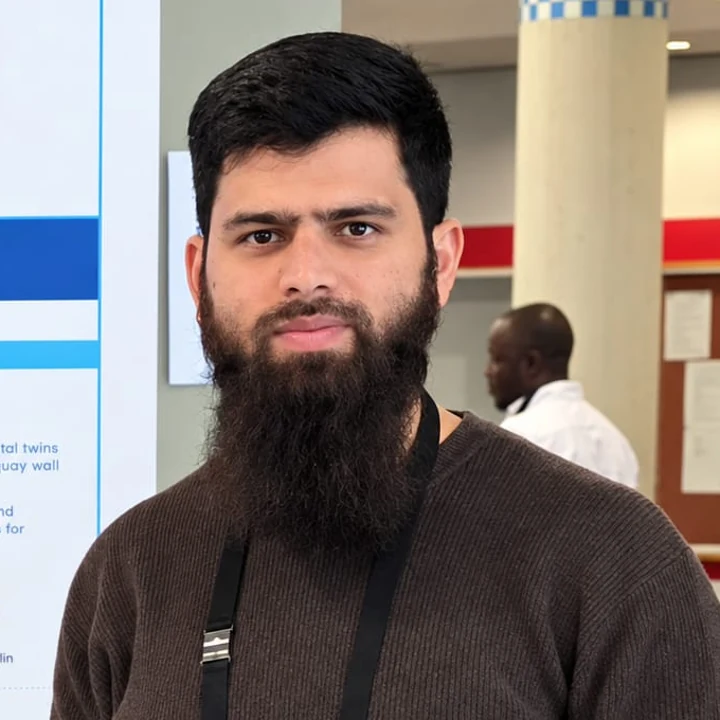
Dr. Abdul Waris
Research Associate, Chair of Geotechnical Engineering, University of Siegen, Germany
Ph.D. in Geotechnical Engineering, IIT Hyderabad · Prime Minister’s Research Fellow
Dr. Abdul Waris is a Research Associate (Wissenschaftlicher Mitarbeiter) at the Chair of Geotechnical Engineering, University of Siegen, Germany, where he teaches, mentors and supervises Master’s students. His research covers reliability analysis, uncertainty quantification and machine learning in geotechnical engineering, with a focus on surrogate modelling, offshore geotechnics, and probabilistic, data-driven approaches to geotechnical risk assessment.
He holds a Ph.D. in Geotechnical Engineering from IIT Hyderabad, where he was a Prime Minister’s Research Fellow. His doctoral thesis, “Reliability Analysis of Unsaturated Finite Slopes under Rainfall Conditions Using Data-Driven Computational Frameworks”, was supervised by Prof. B. Munwar Basha, and his Ph.D. research received the Research Excellence Award 2026 at IIT Hyderabad.
Full profile, publications & talksBefore you register
Do I need to know Python or Machine Learning?
No. The course starts from Python basics inside Google Colab and builds up to ML step by step. A basic understanding of Civil Engineering concepts is all you need.
Do I need a powerful laptop?
No. Everything runs in Google Colab in your browser, so any modest laptop works, even a Chromebook. You will not install Anaconda, MATLAB or any other desktop software at any point in the course.
How much does the course cost?
The early-bird and regular fees for each participant category are shown on this page. Your exact total, including any tax, is confirmed at checkout before you pay. Students and researchers registering together as a group of two or more save 5–15%.
What if I miss a live session?
Session recordings stay available for one month, so you can catch up on anything you miss.
Will I get a certificate?
Yes. Participants receive a course completion/participation certificate.
When does the first cohort start?
First cohort starts Saturday, 17 October 2026 · Sessions at 13:00 UTC. The full session calendar is sent to registered participants.
Save your seat in the first cohort.
Register in about a minute. Your seat is confirmed as soon as your payment is.